The root after harvest
A ginseng root comes out of the soil fresh and rich in moisture. It will not keep for long in that state. The methods developed for preparing it answered, among other things, a practical question: how to store a harvest and let it travel. In the Korea Ginseng Association’s historical booklet, drying and steaming belong to that work of preservation.
Fresh, white and red ginseng are not three different plants. They begin with the root of Panax ginseng; what changes is what happens after harvest. That simple distinction helps make sense of the names before we add more recent terms such as “extract” and “fermented”.
White is dried; red is steamed
White ginseng is dried root. Traditional accounts describe further steps, including lightly peeling the root before drying it. For red ginseng, the root is steamed first and then dried. Steam and drying change its appearance: the colour deepens and the texture becomes firmer. “Red” therefore describes a preparation, not the colour of a root in the ground.
The two forms remind us how much of a product takes shape after it leaves the field. In a whole dried root, we can still see the original outline. In a dark extract inside a glass jar, that outline is no longer visible. Between the two lie a series of decisions about preparation.
From dried root to extract
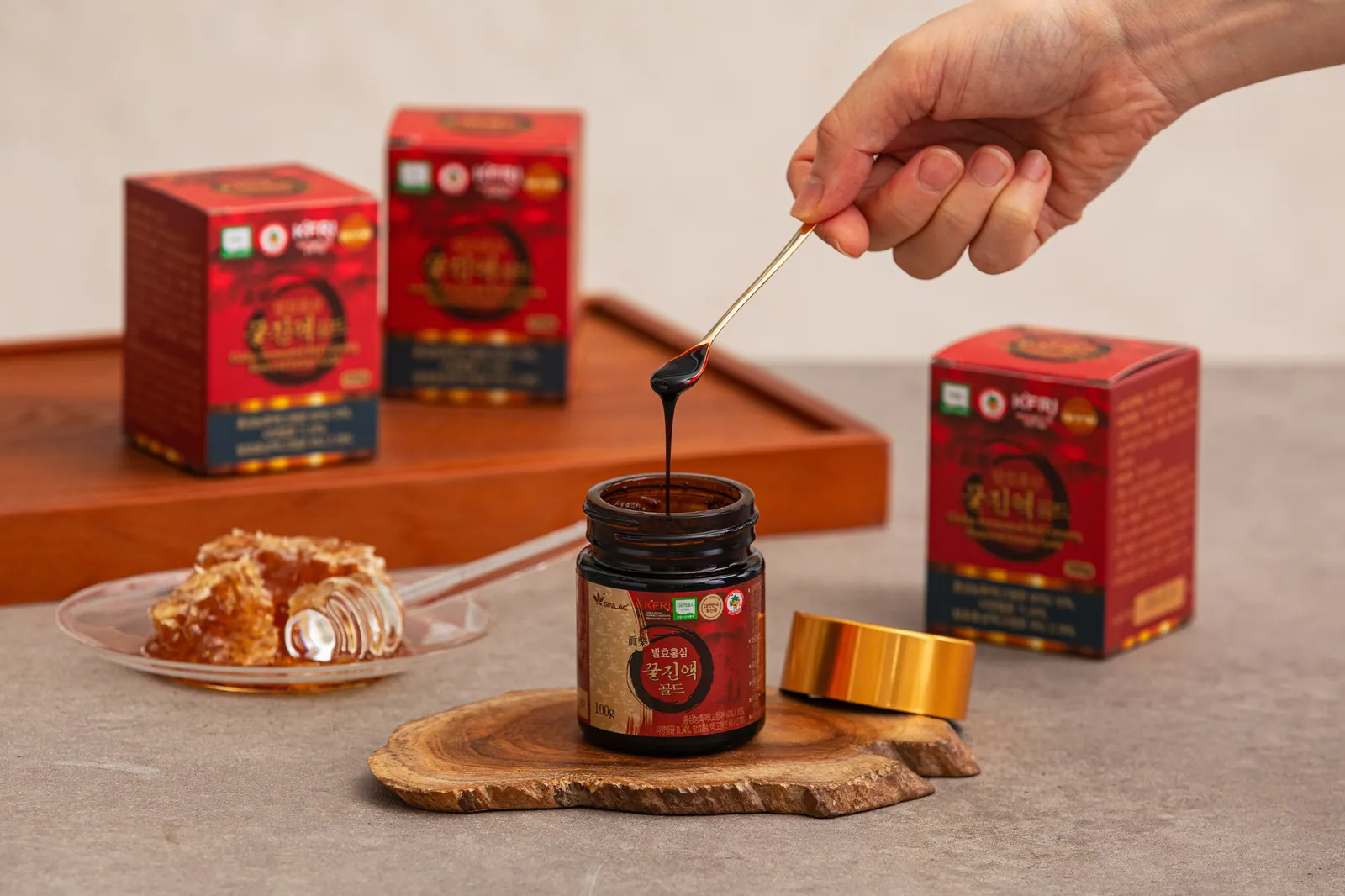
An extract is a different product form, not another name for a dried root. In the Ginlac collection, 6 Years Extract Gold contains red ginseng extract made from six-year-old roots. Its glass jar holds extract rather than a whole dried root, with a composition stated for that product.
The distinction matters when reading the label. “Six-year” tells us about cultivation; “red” describes steaming and drying; “extract” tells us about the form inside the jar. According to the producer’s directions, it may be taken on its own or diluted in water.
Fermentation in the formula
Some Ginlac products combine red ginseng extract with a fermented ingredient. Fermentation is a different processing step from the steaming and drying used to make red ginseng. The word in a product name does not, on its own, tell us how much fermented ingredient is present.
Duo Gold combines 70% red ginseng extract with 30% fermented red ginseng preparation. Fermented Extract Gold has a different formula: 90% red ginseng extract and 10% fermented extract. Comparing the two shows why it is worth reading each product’s ingredients separately.
What the ginsenoside figure measures
An unfamiliar word often appears in descriptions of ginseng extracts: ginsenosides. These are characteristic compounds of Panax ginseng. When a formula lists “total ginsenosides”, it gives a quantity with a unit of measurement. 6 Years Extract Gold lists 80 mg/g: 80 milligrams per gram of product.
That figure belongs to this particular formula. Read it alongside the product name, the other ingredients and the pack size — just as you would read the proportions of the two fermented-ginseng extracts. An unfamiliar word on the label becomes a more useful detail about what is inside the jar.
Reading the label
Terms on a label describe different things: drying makes white ginseng, while steaming followed by drying makes red. Extraction produces a different product form. Some formulations also include a fermented ingredient. These are distinct choices in preparation, not four names for the same thing.
Alongside these terms, check ingredient proportions, the units used for ginsenosides and the directions on the specific package. That makes it easier to distinguish a six-year-root extract from a blend with a fermented ingredient or a drink containing ginseng.