Two roots in a letter
Kim Jeong-hui was a scholar and calligrapher of the Joseon dynasty. During a visit to China in 1809, he met the older scholar Weng Fanggang. When Kim returned to Korea, their acquaintance continued through letters, books and gifts. Among those gifts were ginseng roots. An old letter of thanks speaks of two roots reaching the teacher’s hands. Their journey made a distant friendship tangible.
The Korea Ginseng Association preserves the exchange in a chapter about giving. Its charm lies in the details: a letter travelling with a parcel, the choice of a root rather than an anonymous object, a bond maintained long after the men had met. For them, ginseng was something to keep, send across a distance and offer with personal meaning.
From mountain to field
For centuries, people sought the root in the wild. Cultivation gradually changed its place in Korean life: searching the hills gave way to sowing seed, choosing ground and waiting for the crop. Joseon-era texts already discuss seeds, planting methods and tending the root. This knowledge did not arrive in a single flash of invention. It grew over many seasons in the field.
The association’s booklet names several places with accounts of early cultivation, including Hwasun, Punggi and Geumsan. Each has its own records or local traditions. Rather than one birthplace, they give us a map of people experimenting with ways to grow ginseng. That change also helps explain how a once elusive root came to travel more often as a gift.
A gift carries the sender with it
Another account in the same chapter has Kim Jeong-hui sending ginseng to his friend Gwon Don-in during a period of exile. The distance between them was more than geographical. The parcel entered their correspondence as a way to sustain their friendship; the recipient wrote back with thanks.
Historical accounts also place ginseng among gifts to visitors and officials. Sometimes the gesture was private; sometimes it belonged to public life. In either setting, the root carried something of the place and labour that had brought it there. To give it was not simply to hand over an object. It was a choice that said something about the relationship between giver and recipient.
How a root travelled
A fresh ginseng root contains plenty of moisture. If it was to pass through markets and across borders, keeping it was a practical concern. Drying produced white ginseng; steaming followed by drying produced red. The association’s historical account connects the development of these preparations with storage and transport. The form of the root changed with the distances it was expected to cover.
So the history of giving also passes through the preparation room and storehouse, not only the table where a parcel is opened. Someone had to harvest the root, prepare it and protect it on its journey. A gift reached its recipient because of many small tasks that never appeared in the accompanying letter.
A case for the present
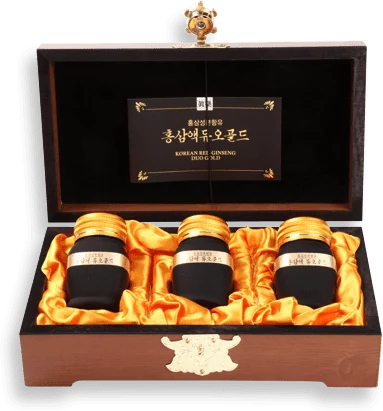
Presentation has changed. Today, the 100 and 150 g editions of Ginlac Duo Gold come in a wooden case, with glass jars inside. The contents combine red ginseng extract with a fermented red ginseng preparation. Wood, glass and the moment of opening belong to the present day; together they make a gift ready to give.
The modern case does not reenact a Joseon ceremony. Yet the old correspondence suggests something familiar: the wish to choose a gift with a particular person in mind. The wooden case, glass jars and Korean root give Duo Gold a character of its own.
The moment of giving
A good gift is never entirely explained by its price or its wrapping. Someone thought of its recipient, selected a particular form and brought it to them. With ginseng, that personal gesture meets a much longer journey: fields and agricultural writing, then letters connecting Seoul with China. A wooden case offers a new setting for an old human impulse.
We do not know what Weng Fanggang said when he opened the parcel containing two roots. We do know that he wrote back, leaving a record of the gift in their correspondence. This small, real story is a reminder that a gift often matters because of the care taken in choosing it and the person receiving it.